 ™
™Served today.Prepared tonight.
A plain-language conversation. Documents, if the litigant has them. Facts, confirmed.
A summons + 25 minutes + George = a prepared litigant.
Written by humans. Delivered by AI. Guidance traces to facts the SRL provided and confirmed, and is limited to procedural guidance and legal information, a boundary we call Engineered Restraint.
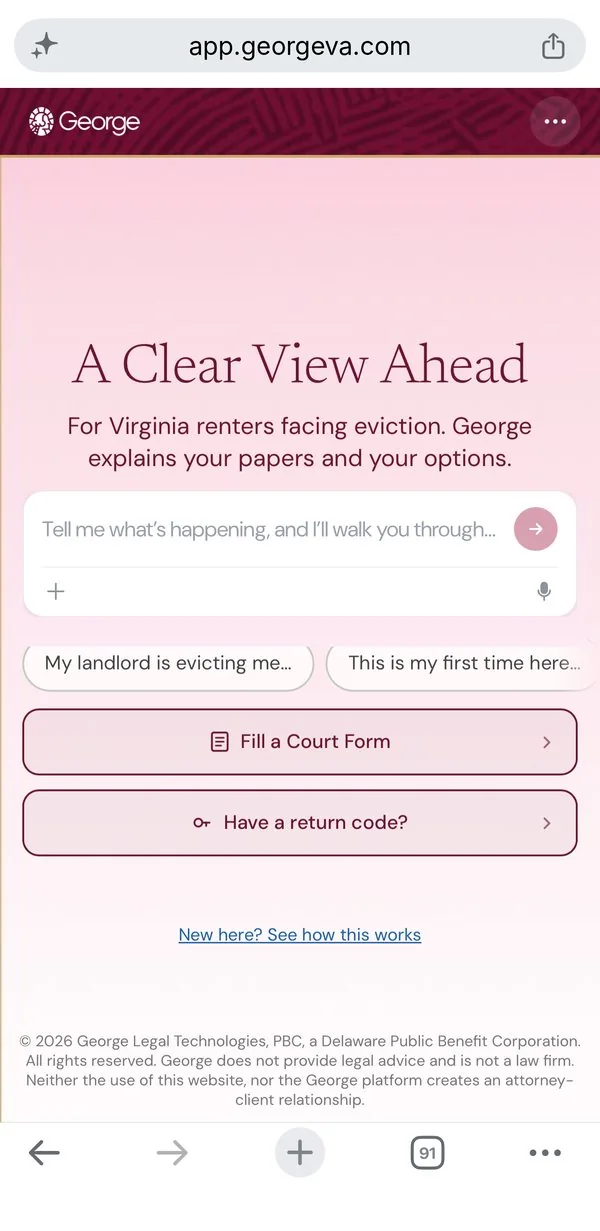
One session.Four stages.
Two rounds of questions. Two confirmations. Then the plan, and room to ask.
Guided Conversation
A structured intake captures the facts. AI is the conversation interface; it cannot choose what questions to ask. SRL responses switch legal modules on or off.
Read Back
The SRL confirms the facts.
Options Interview
Each remaining module runs a scripted interview, capturing distinctions that change applicability. The process is deterministic, repeatable, and auditable. George isn't a black box.
Read Back
The SRL confirms again.
The Plan
Assembled from human authored, pre-reviewed content matching the SRL's confirmed answers and delivered in plain language. SRLs are stepped through forms in plain language.
Ask George™
A content- and context-rich Q&A comes next. SRLs dig deeper, ask questions and complete forms. A Return Code brings them back to add new papers and ask again, with no account and no password.
Documents are optional. An SRL can upload a summons, a notice or a lease, and George reads it and asks the SRL to confirm what it read. George builds the plan with or without them.
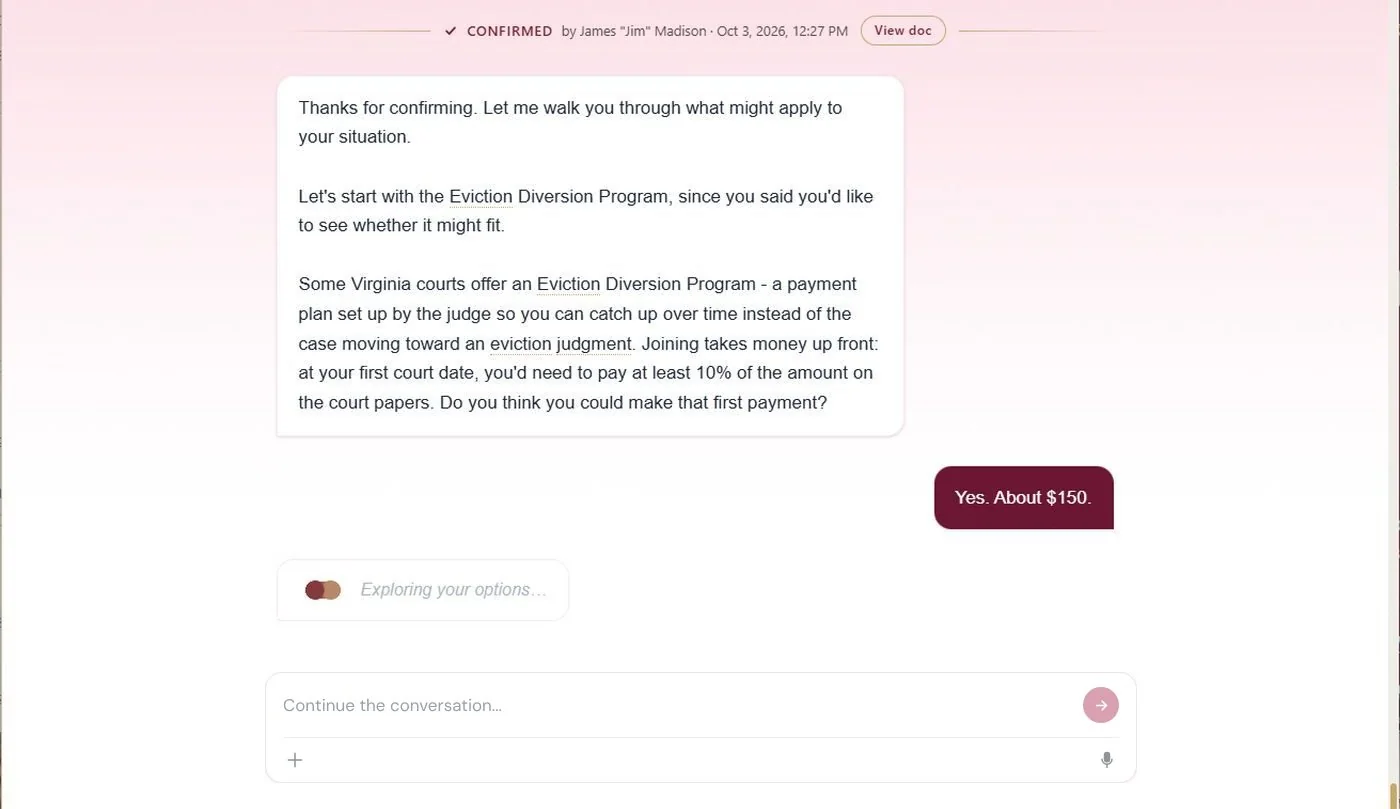
A Read Back, confirmed by a test persona, and the conversation that follows.
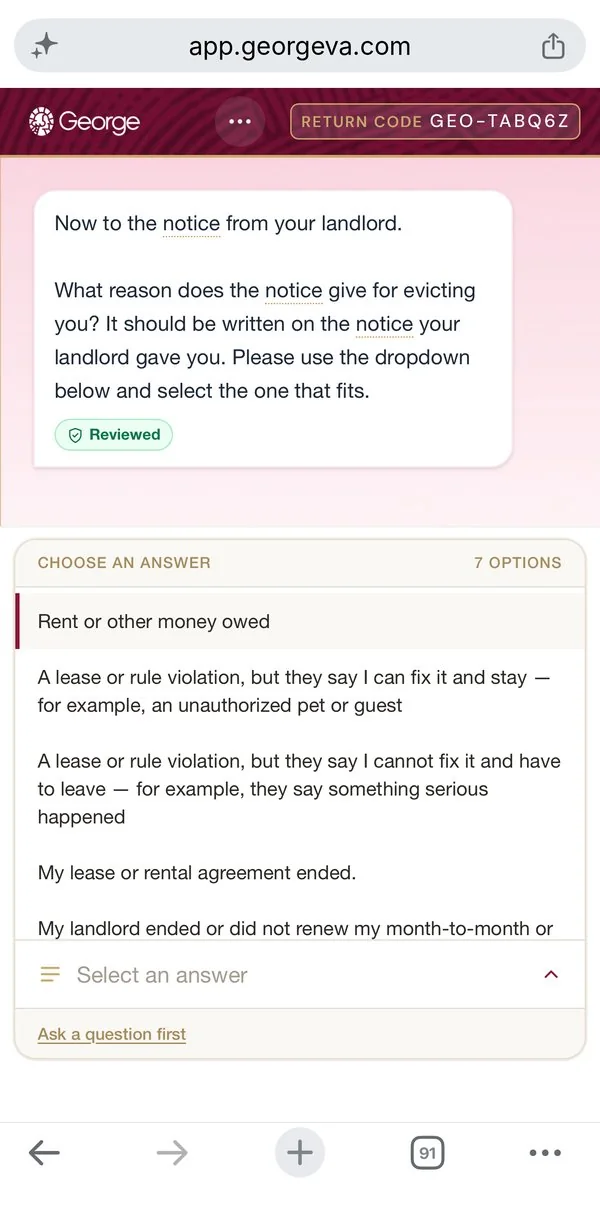
Answer choices in the Guided Conversation.
The plan goes home.George goes with it.
The plan downloads as a PDF, or an SRL can text a link to their own phone, even from a courthouse kiosk. A Return Code reopens the session, with no account and no password.
The plan is organized by the questions an SRL asks. "How do I get ready?" "What happens when I get there?" It covers how to prepare for court, how the hearing works, the SRL's situation and key dates, the options and defenses that may apply, the forms that fit, and how to reach legal aid.
The plan is the SRL's own preparation. It is not a court filing, it is not designed to be handed to the judge, and it carries the date it was prepared. It also asks to be checked. The plan says George can make mistakes, and asks its reader to check every date and amount against their own court papers.
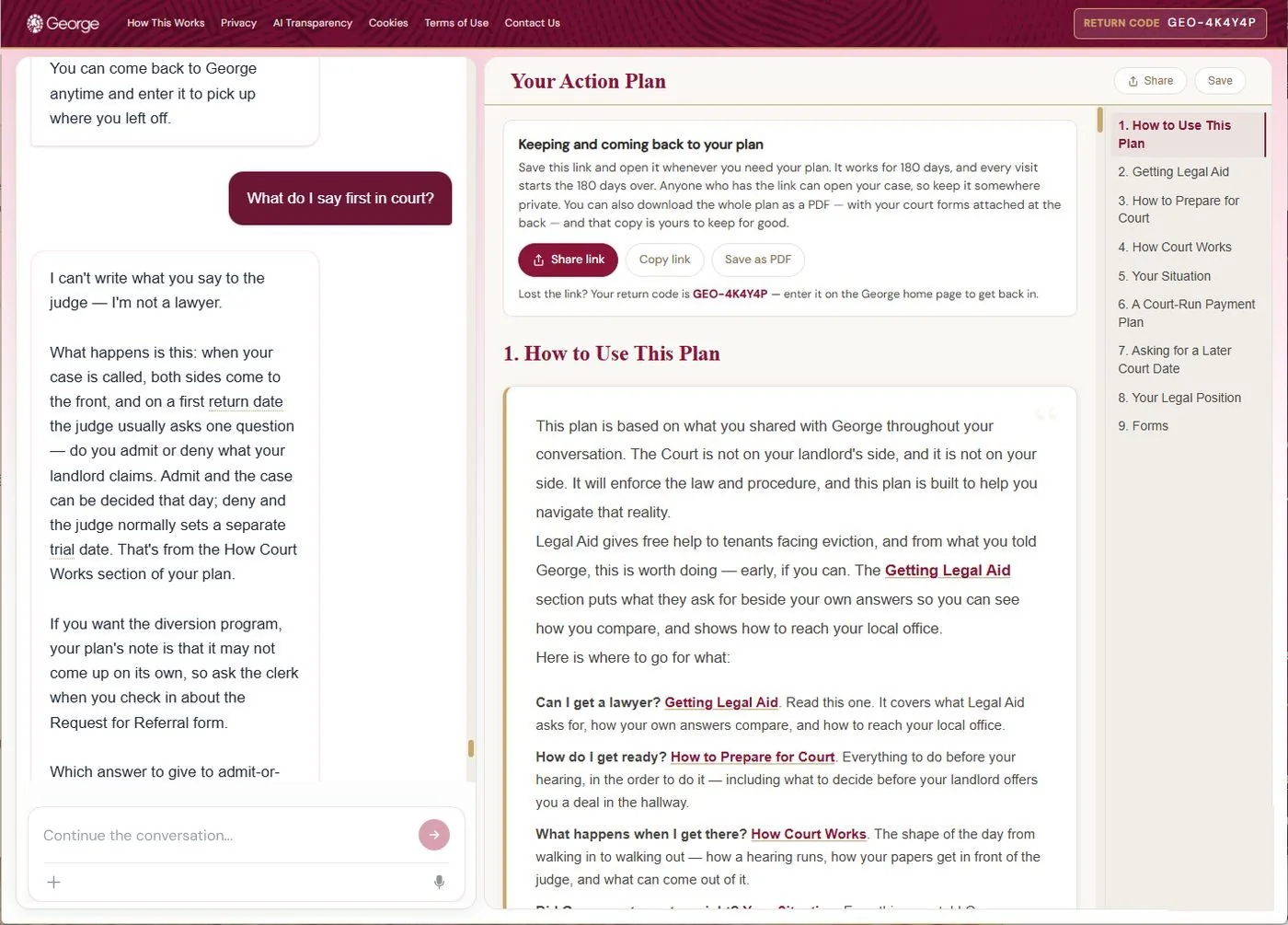
"How to Use This Plan," and the Return Code as an SRL meets it. From a session with a test persona.
Every answerhas grounds.
The plan is where the questions start. In Ask George, an SRL digs deeper, and each answer draws on the facts the SRL confirmed and the guidance humans wrote. George calls these Grounded Answers.
An SRL can come back with new papers and ask again, while getting ready for court or on the way into the courtroom. Every answer stays within Engineered Restraint. "Grounded" says where an answer is drawn from. It is not a promise that an answer is correct.

The court's forms.The litigant's facts.
George steps an SRL through each field of the court's own form and explains it in plain language. Launched from the plan, the form arrives pre-filled with what the SRL already confirmed.
If their only need is a form, the SRL launches the form filler from the George platform landing page, no need for the guided conversation or legal options interview. The SRL completes the form, reviews it, and files it on their own. George files nothing with the court.
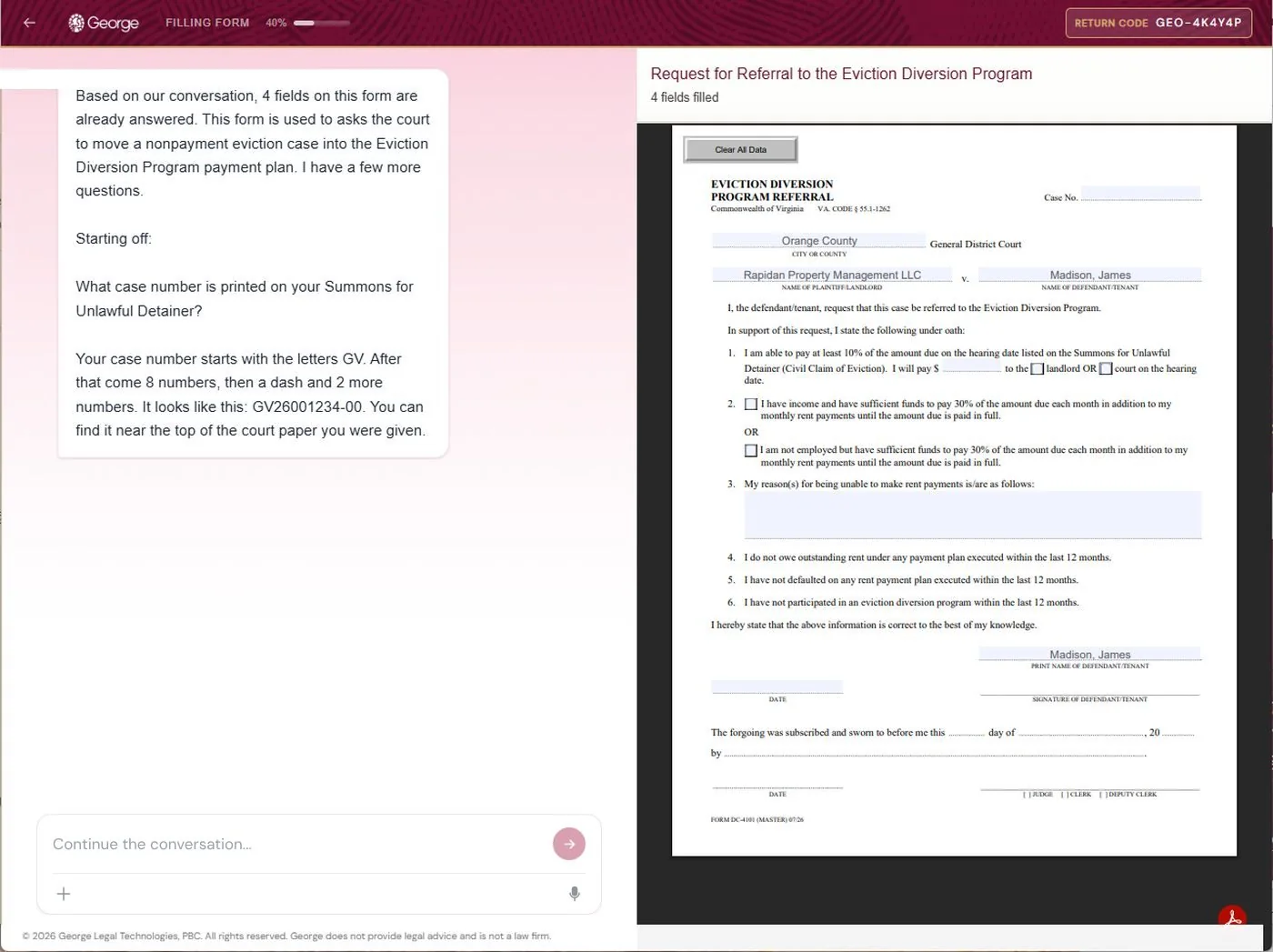
The form filler beside the court's form. Four fields arrived pre-filled from the conversation.
Last night, an SRLasked a chatbot.
The response was fluent, but the litigant did not know to include the jurisdiction and other key facts, and the chatbot did not know to ask. Nobody benefits. Virginia can choose which AI is within an SRL's reach, and whether a human answers for it.
No court can stop a litigant from consulting AI, and a chatbot answers only the question it is given.
George uses AI to hold a plain-language conversation with the SRL. A legal decision tree decides which questions are asked, and the plan's guidance is written by humans, in advance. George does not train, host or operate an AI model. When George errs, there is a human to answer for it, a process to correct it, and a record of what happened. George isn't a black box.

The George Standard™
Most AI is hearsay. It repeats what it read. By design. George's plan is deterministic, also by design.
Every point traces from a fact the litigant confirmed to content written in advance. Traceable, auditable, and ready for cross.
 Authored GuidanceWritten by humans. Delivered by AI.
The law is the source. Humans author the guidance that explains it, in advance, in units called Modules. AI delivers it in conversation. George's Authored Guidance is written by humans from Virginia eviction law and mapped to Virginia's court forms. A reviewer can read a Module in full, the way a court form or a brochure is read.
 Confirmed FactsHeard. Checked. Confirmed.
George listens for facts, checks them against previous answers and uploaded documents, and reads them back. Only the facts an SRL confirms shape the plan.
"Confirmed" means the SRL has reviewed the facts and agreed that George recorded them correctly. George cannot confirm that a fact is true.
 Deterministic Personalization™Same facts. Same plan. Every time.
A legal decision tree, built from the governing law, matches each SRL's Confirmed Facts to Authored Guidance. The plan is individual to the SRL and repeatable by design. Individualized without being improvised.
One example: an SRL confirms they paid for repairs the other party would not make. That answer turns on the repair topic, and George asks the questions that go with it. George calls this Gating. Fact Trace then follows each fact from the conversation to the legal options to the plan, so it stays consistent.
 Engineered Restraint™George stops before advice begins.
Options, deadlines and explanations are George's work. Advice is counsel's. The Guard, an independent AI agent, reads every message before an SRL sees it and holds George to that line. The Guard checks the boundary only. Accuracy rests on Authored Guidance.

The only thing George practicesis restraint.
Options, deadlines and explanations are George's work. Advice is counsel's. That is the hard stop, engineered in three layers: structure, human-authored guidance, and a check on every message. Engineered Restraint is the practice.
"What should I do?"
It is the question hiding in every other question, and George can't answer it. George says so and points to legal aid, court self-help resources or counsel. Declining is a designed response, tested and documented. George explains, then stops.
Before a session begins, every SRL accepts four statements, and the first is that George does not give legal advice. An output that crosses the line is treated as a critical compliance issue with same-day escalation.
On July 1,five days became fourteen.
Virginia changed the nonpayment notice period in 2026, and George's guidance reflected it before the effective date. Guidance is only as good as its last update. The law moves, and George moves with it.
Start withone scenario.
25 minutes, one eviction scenario. We will walk it through George, end-to-end, and talk about a fit for your court or program. George is seeking institutional partners today.
davidgibson@georgeva.com
469.763.0775